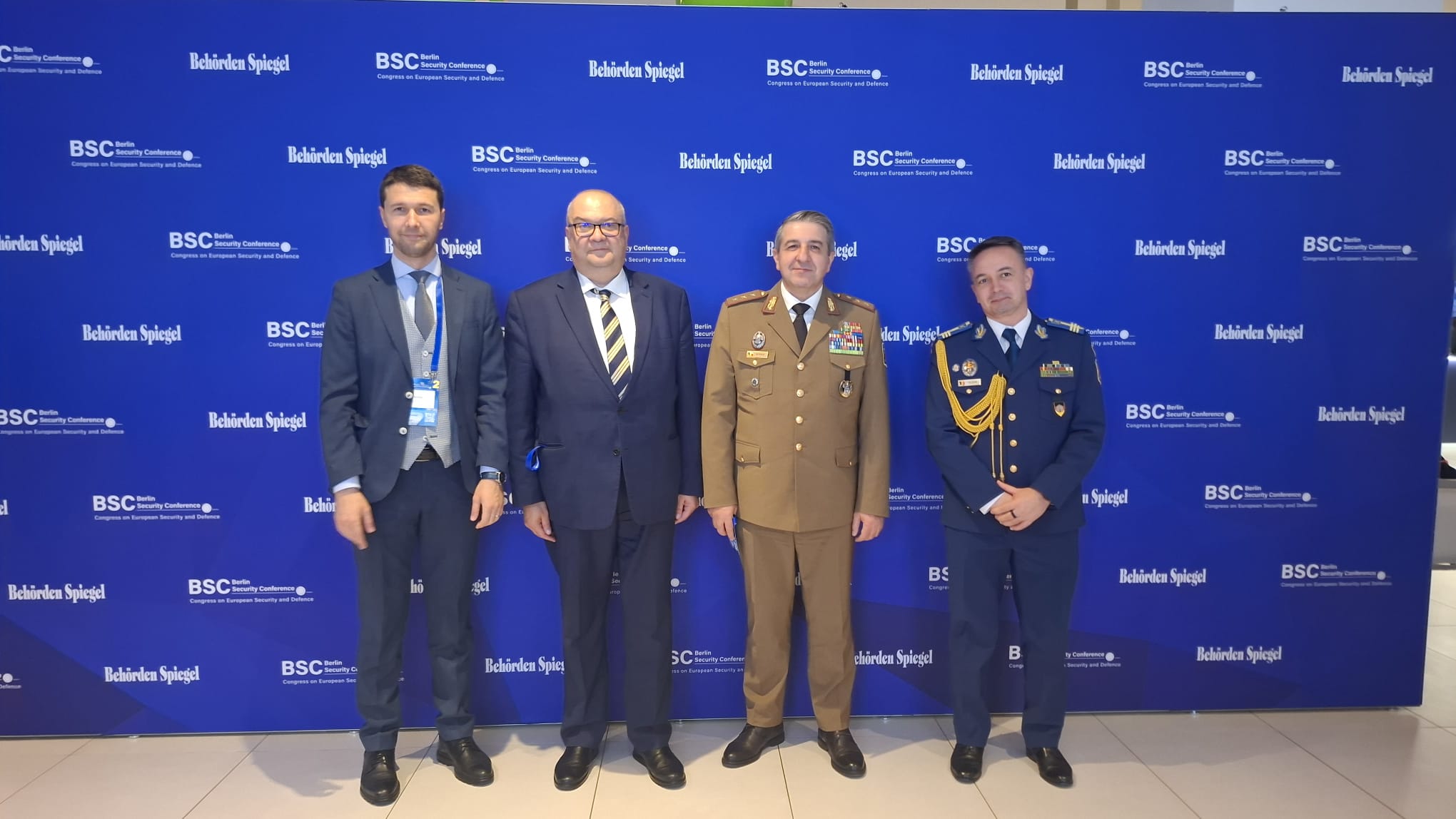
New Strategy Center participated in the Berlin Security Conference on 3–4 November 2026, one of Europe’s leading events dedicated to security and defence, held in Germany.
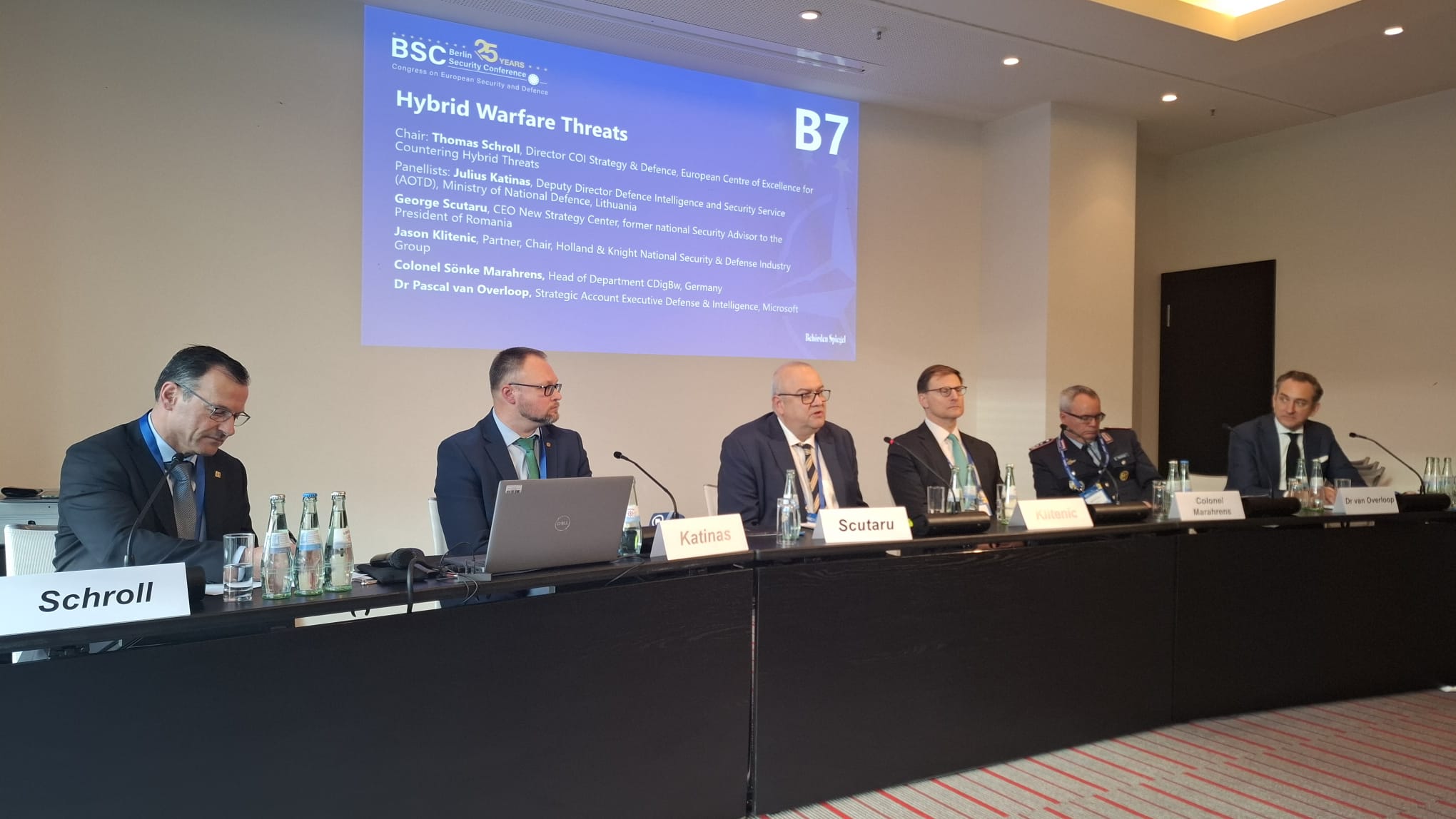
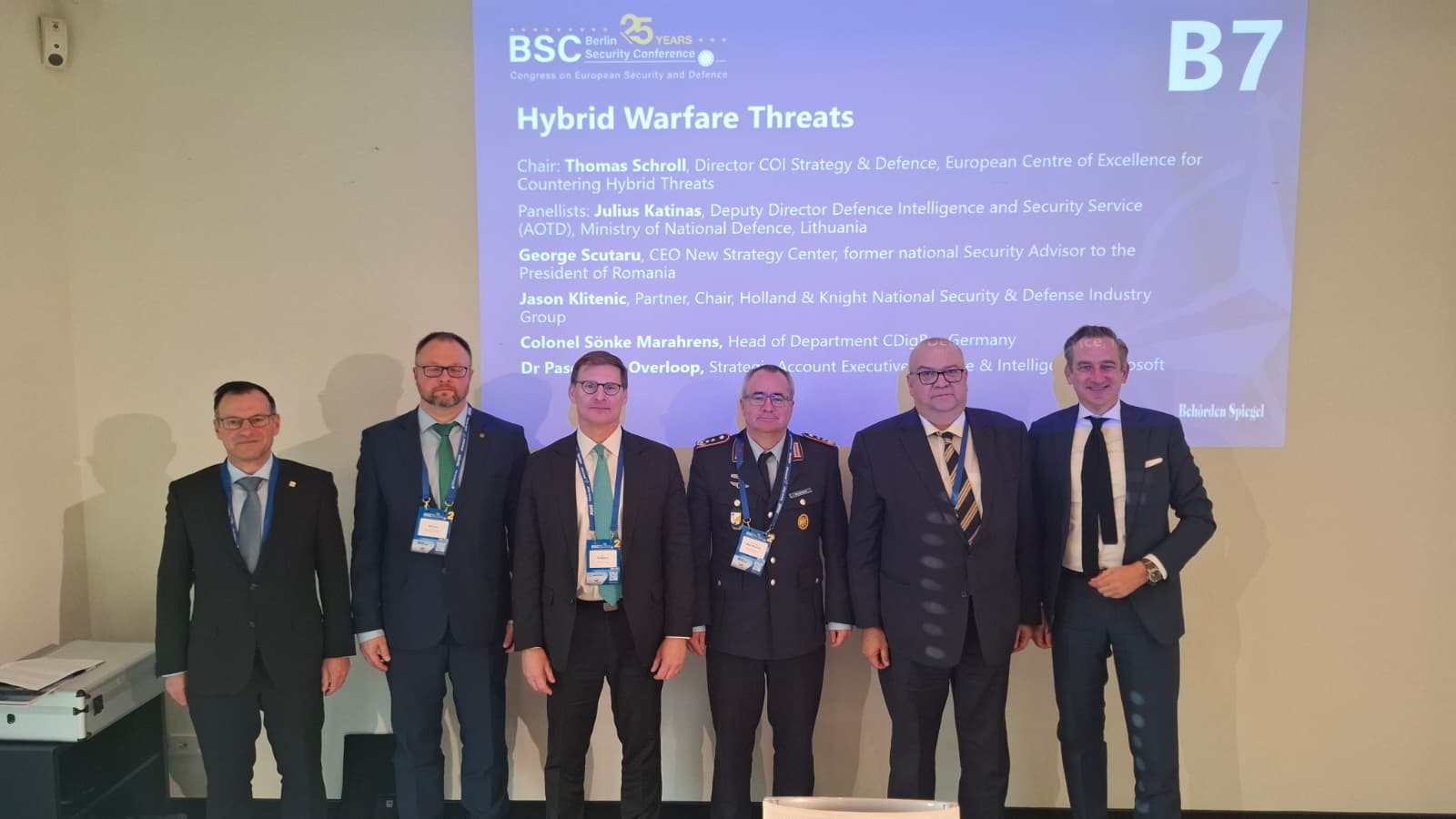
George Scutaru, CEO of New Strategy Center, was a speaker in a panel dedicated to hybrid threats, moderated by Thomas Schroll, a representative of the European Centre of Excellence for Countering Hybrid Threats.
Other participants in the discussion included: Julius Katinas, Deputy Director of Lithuania’s Military Intelligence Service; Jason Klitenic, Partner and Chair of Holland & Knight’s National Security and Defense Industry Group; Colonel Sönke Marahrens, representative of the German Armed Forces, specialising in cyber and information operations; Pascal van Overloop, Strategic Account Manager, Defense and Intelligence, Microsoft.
The discussions focused on how Russia employs a wide range of hybrid tools to undermine the stability of NATO and EU member states and weaken Western support for Ukraine. Participants examined acts of sabotage, cyberattacks, large-scale disinformation campaigns, and incursions by Russian drones into NATO airspace.
During his intervention, George Scutaru presented the security situation in the Black Sea, which he described as the most dangerous area in the world for maritime navigation at present. He emphasised that Russia is seeking to economically strangle Ukraine through attacks on port infrastructure and disruptions to Ukrainian grain exports to international markets. Threats to freedom of navigation have direct consequences not only for Ukraine’s economy but also for regional connectivity and energy projects.
George Scutaru called for a much stronger NATO deterrence posture in the Black Sea, including the deployment of additional intelligence, surveillance and reconnaissance (ISR) capabilities, as well as kinetic capabilities necessary to intercept and neutralise Russian drones. He also highlighted Romania’s experience in countering drone threats, noting that Romanian pilots have so far shot down six Russian drones, the highest number of such interceptions carried out by pilots from any NATO member state. Nevertheless, he stressed the need for a significantly stronger NATO military presence and enhanced capabilities in the region.
Referring to the strategic particularities of the Black Sea, George Scutaru explained that the restrictions imposed by the Montreux Convention limit NATO’s ability to strengthen its naval presence by deploying warships from outside the region under the current wartime circumstances. For this reason, the Alliance must compensate for these constraints by strengthening other military capabilities, particularly by increasing the density of sensors, surveillance assets, and interception and strike systems deployed in Romania and across the Black Sea region.
Another important topic addressed was Russia’s strategy of controlled escalation and its use of hybrid threats to influence European public opinion. George Scutaru explained that Russia seeks to create the perception of an imminent war between Russia and European NATO member states, generating fear among the population and pressure on European political leaders to reduce their support for Ukraine.
“Promoting the idea that the war must end immediately, regardless of the terms, ignores the fact that such an outcome would, in reality, amount to Ukraine’s capitulation. We must understand that this war is not only about Ukraine’s fate, but also about the future of security across Europe,” George Scutaru stressed.
He warned that Russia’s strategic objectives extend far beyond Ukraine’s territory, as Moscow seeks to impose a new European security architecture. In this context, he recalled that, in December 2021, Russia demanded the withdrawal of NATO military infrastructure from countries that joined the Alliance after 1997.
“Russia wants to impose a new security architecture in Europe, with a buffer zone stretching from the Adriatic Sea to the Baltic Sea. This would primarily undermine the security of countries that became NATO members after 1997. Such a prospect is unacceptable to us,” George Scutaru warned.
New Strategy Center’s participation in the Berlin Security Conference is part of its ongoing efforts to highlight the strategic importance of the Black Sea for Euro-Atlantic security, raise awareness of the threats facing the region in the context of Russia’s war of aggression against Ukraine, and advocate for a stronger NATO deterrence and defence posture in the Black Sea.