
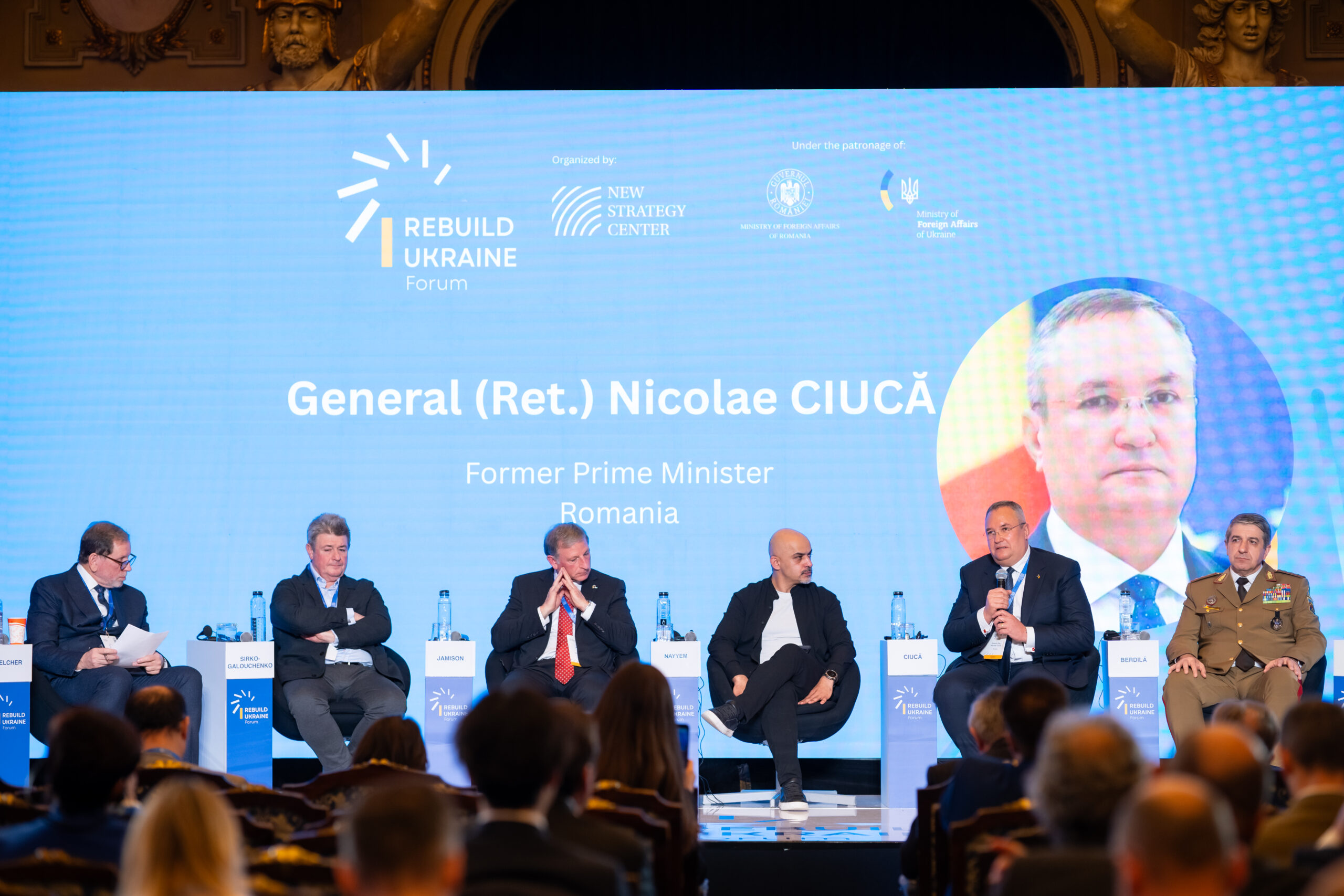
Panel VIa, dedicated to the theme “The Russia–Ukraine Drone War: Innovation on the Front Line and Beyond. What Can We Learn for Our Own Defense?”, was moderated by Mr. Greg Melcher, Chief Operating Officer of the New Generation Warfare Centre (USA). The event brought together Mr. Andriy Sirko-Galouchenko, expert in UAV development for military applications; Mr. Terry Jamison, International Director for Vertical Take-Off and Landing Aircraft at Boeing; Mr. Mustafa Nayyem, Director of Public Affairs at GTX; General (ret.) Nicolae Ciucă, former Prime Minister of Romania, and Lieutenant General Iulian Berdilă, Deputy Chief of Defence for Operations and Training.
In their interventions, the speakers emphasized that what had once been viewed as a distant technological horizon had already become an operational reality. Advances in unmanned aerial systems, open architectures, and rapid capability integration demonstrated that the future of warfare was far nearer than most Western actors had anticipated. Operational experience from Ukraine showed that the accelerated tempo of innovation had triggered a structural transformation in the design of air, land, and joint operations. The combined use of manned and unmanned platforms, along with the need for immediate technical interoperability, was identified as a fundamental requirement of contemporary military adaptation.
The panel highlighted that the proliferation of drones had radically altered operational logic: they were already employed for reconnaissance, precision strikes, logistics, mining and demining, artillery fire correction, and special operations. Large-scale coordinated attacks on critical infrastructure revealed the limits of purely reactive defense, suggesting that neutralizing platforms at their source had become a strategic necessity. At the same time, counter-drone systems were undergoing rapid development, integrating both existing technologies and emerging solutions designed to address the growing volume of low-altitude aerial threats.
The discussions also underscored the strategic dimension of Europe’s vulnerability to hybrid warfare. Conventional threat assessments no longer matched the reality of an adversary operating predominantly through asymmetric, diffuse, and hard-to-attribute means. Seemingly minor incidents—such as unidentified drones appearing near critical infrastructure across Europe—illustrated the gap between public perception, institutional preparedness, and the actual nature of the risk. It was stressed that most European states were not yet adequately prepared to respond to this type of aggression.
Overall, the panel concluded that the drone war represented not only a technological evolution but a profound paradigm shift in the art of warfare. Adapting to this operational environment required institutional agility, short innovation cycles, coordinated investments, and a flexible doctrine capable of rapidly integrating lessons from the Ukrainian conflict. Modern warfare had become a domain in which the speed of adaptation, system integration, and the capacity to respond both offensively and defensively simultaneously were central components of strategic resilience.