
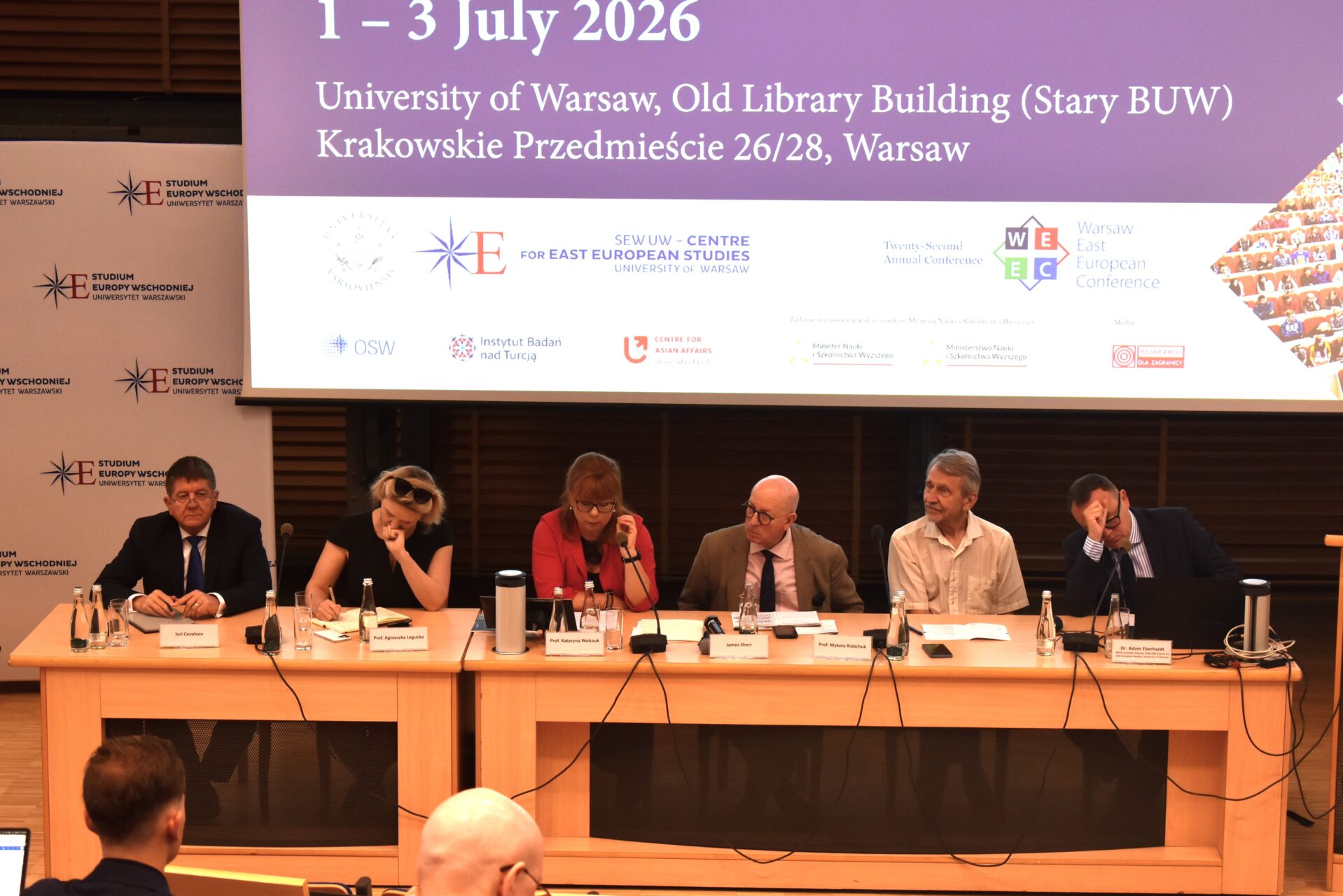
From 1–3 July 2026, Rear Admiral (Ret.) Iuri-Alexandru Covaleov, Senior Associate Expert at the NSC, is participating in the 22nd edition of the conference “International Order in Transition: Implications for Central and Eastern Europe,” organized in Warsaw by the Centre for East European Studies (SEW UW), University of Warsaw.
On 1 July, Iuri Covaleov participated as a speaker in the opening panel, “Russia’s War Against Ukraine: Ceasefire, Settlement, or Prolonged Conflict?” He emphasized that Russia’s war against Ukraine has fundamentally transformed the Black Sea into a strategic region for both European and global security. The region is no longer viewed merely as a maritime area; rather, the Black Sea is now understood as a geopolitical space whose stability directly affects the European security architecture, global supply chains, migration flows, energy transit routes, food security, and international economic stability.
He also highlighted that an overview of the ongoing diplomatic, military, economic, and societal developments related to the conflict offers little reason for optimism regarding a near-term resolution. At the same time, he noted the tendency to focus primarily on the military dimension of the conflict, although after four years of confrontation, the diplomatic, economic, and societal dimensions have become equally significant.
The NSC expert further pointed out that the expanding strike range of the Ukrainian Armed Forces is reshaping Russia’s defensive geometry. Moscow can no longer rely on distance as a source of security. Strategic depth, one of the traditional pillars of Russia’s defense posture, is becoming contested space. Every successful Ukrainian strike compels Russia to expend additional defensive resources, redeploy systems, reinforce radar coverage, and absorb the growing economic costs of protection.
At the same time, he argued that efforts to reach a ceasefire or peace agreement have become imperative in order to reduce regional tensions with global repercussions. He stressed that achieving a ceasefire or peace agreement in the Russo-Ukrainian conflict would also bring about significant changes in the broader global geopolitical landscape.