
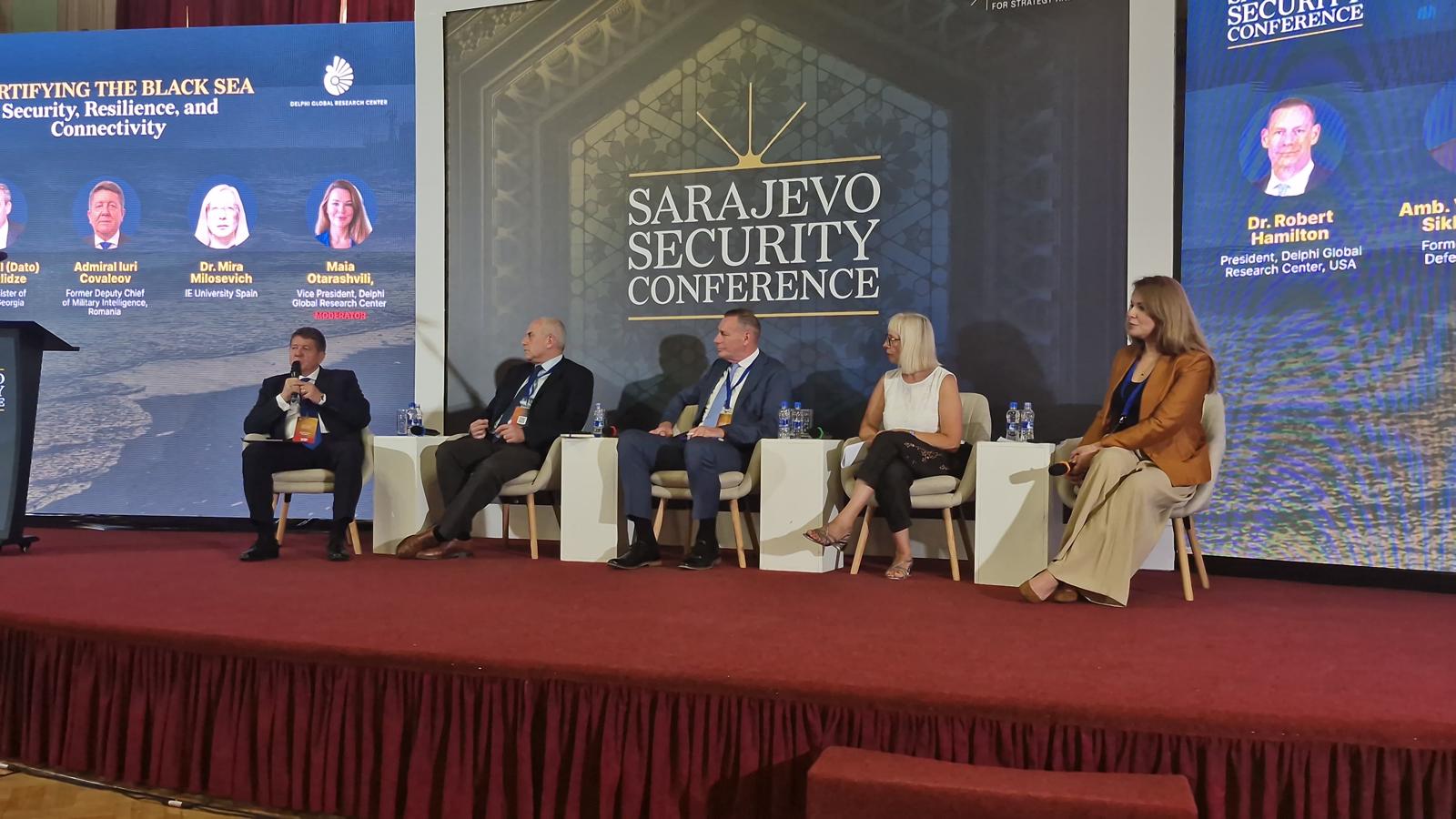
Between 4 and 6 September 2026, Rear Admiral (Ret.) Iuri-Alexandru Covaleov, Senior Associate Expert at the New Strategy Center, participated in the 4th edition of the Sarajevo Annual Security Conference, organized by the New Lines Institute for Strategy and Policy under the patronage of the Ministry of Defence of Bosnia and Herzegovina.
The NSC expert was a speaker on the panel “Fortifying the Black Sea: Security, Resilience, and Connectivity,” emphasizing that the Black Sea region is strategically important as it represents a point of convergence for military deterrence, maritime law, energy diversification, food security, infrastructure protection, hybrid warfare, and Europe’s links with the Caucasus and Central Asia. He also stressed that Russia’s full-scale invasion of Ukraine has transformed the region from an area perceived as peripheral into a frontline for European and transatlantic security.
He further underlined that the strategic dilemma is whether the Black Sea should be treated primarily as a military theatre or as a shared space for security and connectivity. Stability will require both credible deterrence capabilities and pragmatic cooperation conducted below the threshold of armed conflict.
He subsequently addressed the strategic risks facing the region, stressing that the most serious danger is not merely a major conventional conflict, but the gradual normalization of a state of permanent confrontation, fueled by ambiguous actions that allow for plausible deniability. These include, among others, cyberattacks and disinformation, the sabotage of ports, energy facilities and undersea infrastructure, as well as the coercive use of dependencies in trade, migration, energy and transportation.
He also emphasized that transforming connectivity into resilience is imperative, as connectivity projects in the fields of transport, energy and digitalization should be designed as strategic resilience-building initiatives.
Furthermore, he addressed the prospects for a realistic model of regional stability, noting that it is unlikely that the Black Sea will become a demilitarized space or one characterized by full cooperation in the foreseeable future. He stressed that the Black Sea region can become a zone of stability only if deterrence and cooperation develop as simultaneous processes. Therefore, the practical formula is: defence without permanent escalation, connectivity without dependency, and diplomacy backed by credible capabilities.