
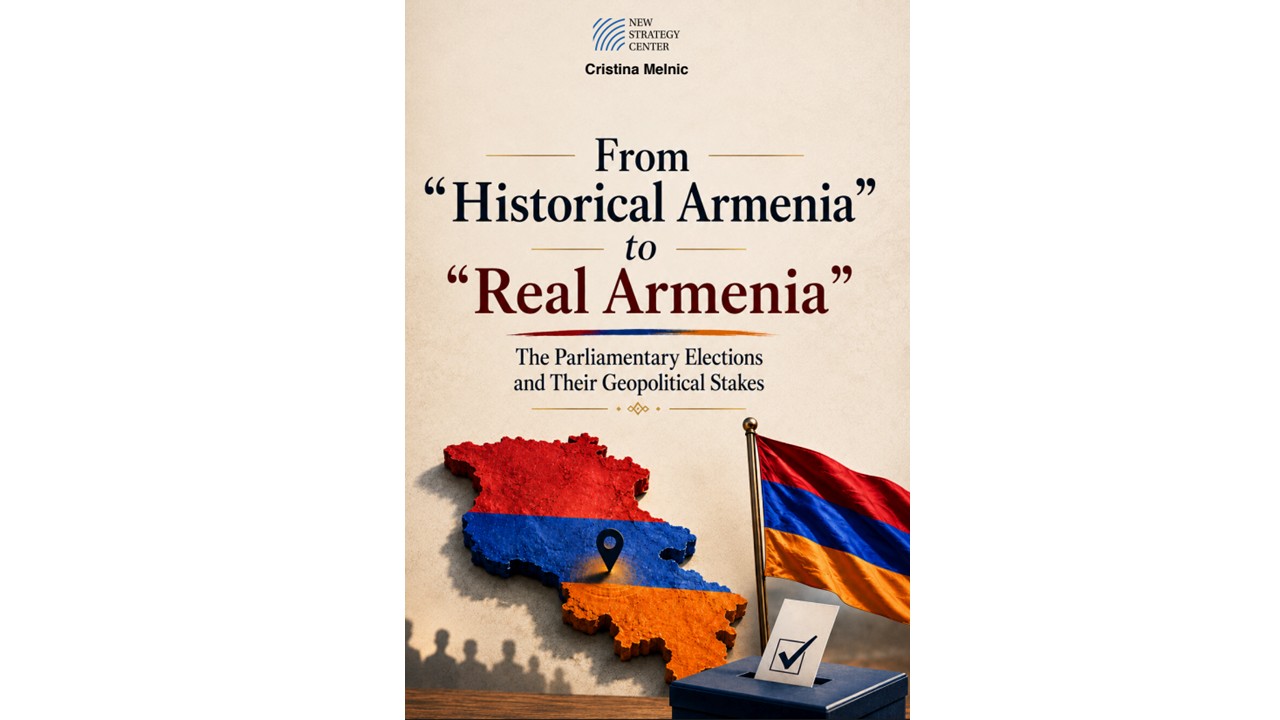
New Strategy Center publishes the study “From Historical Armenia to Real Armenia: The Parliamentary Elections and Their Geopolitical Stakes,” dedicated to Armenia’s parliamentary elections of 7 June 2026 — a vote that goes beyond the logic of a conventional electoral contest and takes on the significance of a major test of the country’s strategic orientation. The first regularly scheduled elections held since 2017 take place in a context marked by the trauma of the loss of Nagorno-Karabakh, the deterioration of relations with Russia, and Armenia’s accelerated rapprochement with the European Union and the United States.
The analysis examines how the elections have become an indirect plebiscite on Armenia’s future: either the continuation of Nikol Pashinyan’s doctrine of “Real Armenia,” focused on state survival, regional normalization, and connectivity, or a return to the logic of a “Historical Armenia,” shaped by territorial claims, collective traumas, and dependence on Moscow. The study explores the impact of the loss of Nagorno-Karabakh on Armenian society, tensions between the government and the Armenian Apostolic Church, the management of displaced persons, and the ambivalent record of Pashinyan’s governance, defined simultaneously by economic growth and severe security vulnerabilities.
Special attention is given to the main political actors — Civil Contract, Strong Armenia, Armenia Alliance, Prosperous Armenia, and emerging parties — as well as to Armenia’s electoral framework, including the “stable majority” mechanism and electoral thresholds. The study also highlights the geopolitical stakes of the vote: Russia’s hybrid and economic pressure, the EU’s support for strengthening democratic resilience, the role of the United States in advancing the TRIPP project, and the positions of France, Türkiye, Azerbaijan, Iran, India, and China.
Through its post-electoral scenarios, the analysis shows that the outcome of the vote will directly influence the peace process with Azerbaijan, the possibility of a constitutional referendum, the future of regional connectivity, and Armenia’s capacity to transform its geographical vulnerability into a strategic advantage.
The author of the study is Cristina Melnic, Expert on International Relations, New Strategy Center.
From Historical Armenia to Real Armenia: The Parliamentary Elections and Their Geopolitical Stakes