
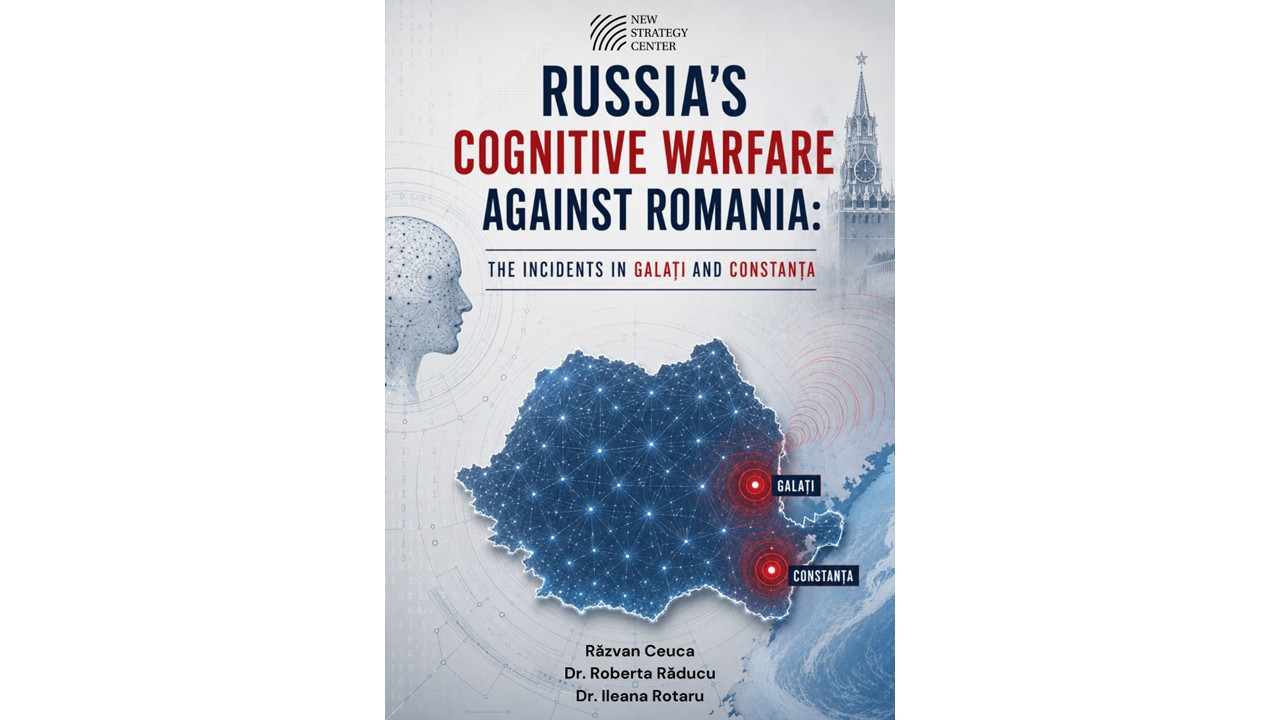
New Strategy Center has published the study „Russia’s Cognitive Warfare Against Romania: The Incidents in Galați and Constanța”, which examines how two security incidents that occurred in May–June 2026 were transformed into opportunities for information manipulation and for eroding public trust in state institutions. The analysis focuses on the incident in Galați, where a Russian Geran-2 drone struck a residential building, and on the incident in the Port of Constanța, where a Ukrainian naval drone, diverted by Russian electronic jamming, self-detonated near critical port infrastructure.
The study argues that these episodes cannot be understood solely as technical-military incidents, but rather as moments that activated Russia’s cognitive warfare against Romania. Operational vulnerabilities, delays in communication, the lack of rapid technical explanations, and public anxiety generated by the proximity of the war in Ukraine created the ideal conditions for amplifying hostile narratives. In the case of Galați, the window of opacity between the drone’s detection and the official communication allowed theories about an alleged “Ukrainian staging,” the Romanian state’s inability to protect its citizens, or the use of the incident to justify military acquisitions to spread rapidly. In the case of Constanța, even the authorities’ operational success was reframed propagandistically as supposed evidence of complicity or prior knowledge of the drone’s trajectory.
Special attention is given to the way in which the Romanian digital ecosystem amplified these narratives through anonymous or generic accounts, repetitive comments, JAQing (“Just Asking Questions”) techniques, and astroturfing mechanisms designed to create the false impression of a popular consensus. The analysis highlights differences between platforms: Facebook functioned primarily as a space for the political structuring of suspicion, while TikTok emotionally accelerated messages of panic, anti-NATO irony, and the delegitimization of authorities. The study identifies the main narratives of the FIMI (Foreign Information Manipulation and Interference) operation: the reversal of responsibility through the “Ukrainian drone” thesis, the SAFE military contracts theory, fears of Romania being drawn into the war, the discrediting of the Romanian Armed Forces, and the personalization of conspiracy narratives through attacks on the political leadership.
The study’s conclusions underline that modern hybrid aggression uses kinetic events as triggers for broader attacks on society’s cognitive resilience. Romania remains vulnerable not only to direct Russian propaganda but, above all, to the instrumentalization of its own fears: fear of war, distrust in institutions, suspicion toward public procurement, and internal political polarization. The study recommends streamlining crisis communication, rapidly releasing preliminary information during the first hours following incidents, strengthening prebunking techniques in the media, and developing a systemic form of digital hygiene adapted to an environment in which online interactions can be simulated and amplified through artificial intelligence.
The study was written by Răzvan Ceuca, International Relations Expert at New Strategy Center; Roberta Răducu, Associate Expert at New Strategy Center, Assistant Professor and Communication Specialist at the National University of Political Studies and Public Administration (SNSPA); and Ileana Rotaru, Senior Associate Expert at New Strategy Center and Associate Professor at the West University of Timișoara.
Russia’s Cognitive Warfare Against Romania: The Incidents in Galați and Constanța