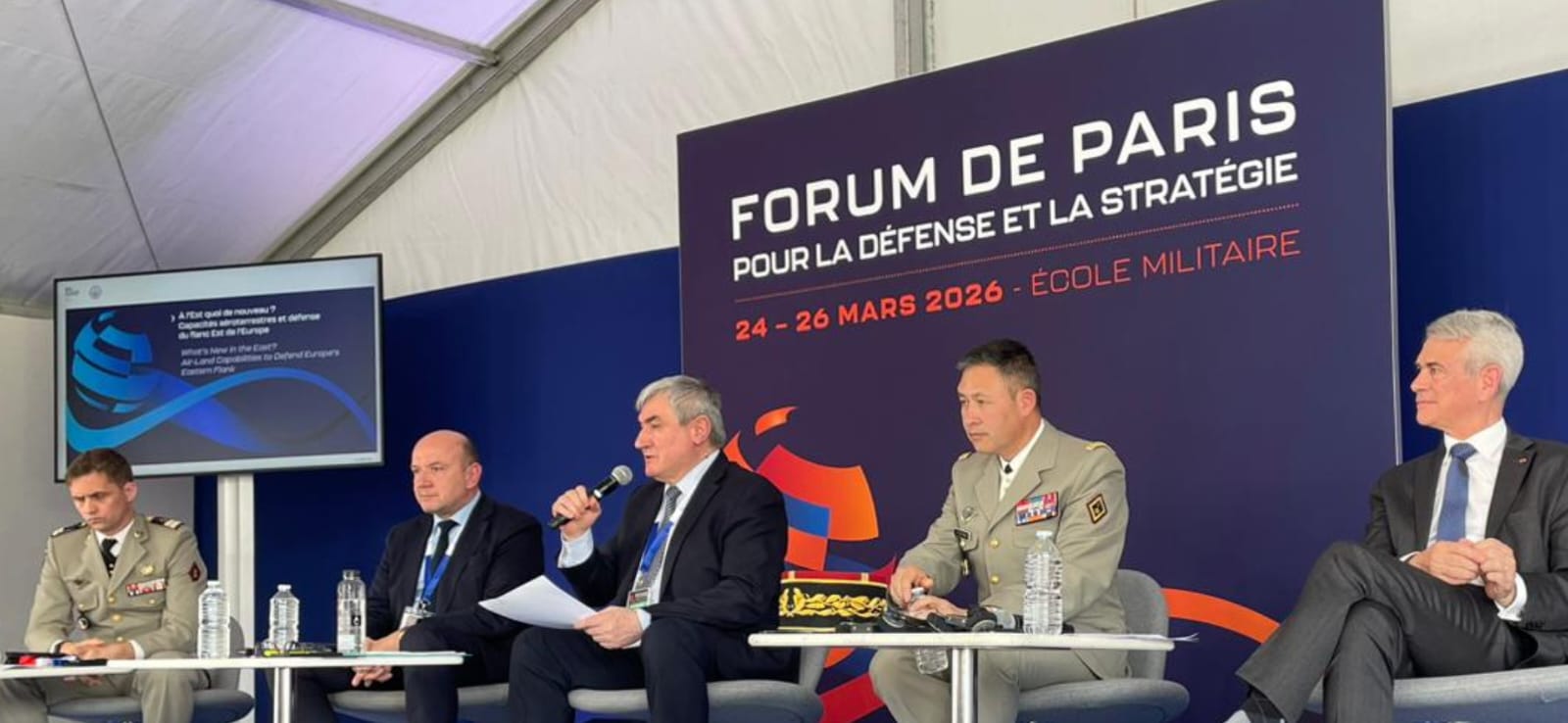
The New Strategy Center participated from March 24–26 in the Paris Defence and Strategy Forum. NSC was represented by Dr. Antonia Colibășanu, Senior Associate Expert at NSC and Associate Professor at SNSPA, and Major General (ret.) Paul Hurmuz, Senior Associate Expert.
Dr. Antonia Colibășanu took part in the session “Academic Symposium: Policy Implications of the Modern Conflict,” where she presented the paper “The Black Sea Borderland: From Crisis Zone to Strategic Corridor in Europe’s Security Architecture – WORKING PAPER.” She highlighted the security challenges in the Black Sea region in the context of the war in Ukraine, emphasizing the geopolitical transformations and their implications for Europe’s security architecture.
Major General (ret.) Paul Hurmuz was a speaker in the panel “What’s New in the East? Questioning Air-Land Capabilities Needed to Defend Europe’s Eastern Flank.” The discussion aimed to highlight the specific challenges faced by Allies on Europe’s Eastern Flank, focusing on three objectives: Allies’ threat perceptions; understanding the current state of their capabilities and needs in the context of a major engagement under NATO Article 5; and assessing the ability of land forces to fight today and prepare for a major future engagement. The presentation underscored that the Russian military represents the Kremlin’s primary instrument for achieving its security objectives, complemented, when necessary, by economic coercion, information operations, and other means. During the debate, it was emphasized that NATO’s military presence on Europe’s Eastern Flank remains a key pillar of its defense and deterrence posture. France has strengthened its role by becoming the framework nation of NATO’s battlegroup in Romania and by increasing its presence and capabilities.