
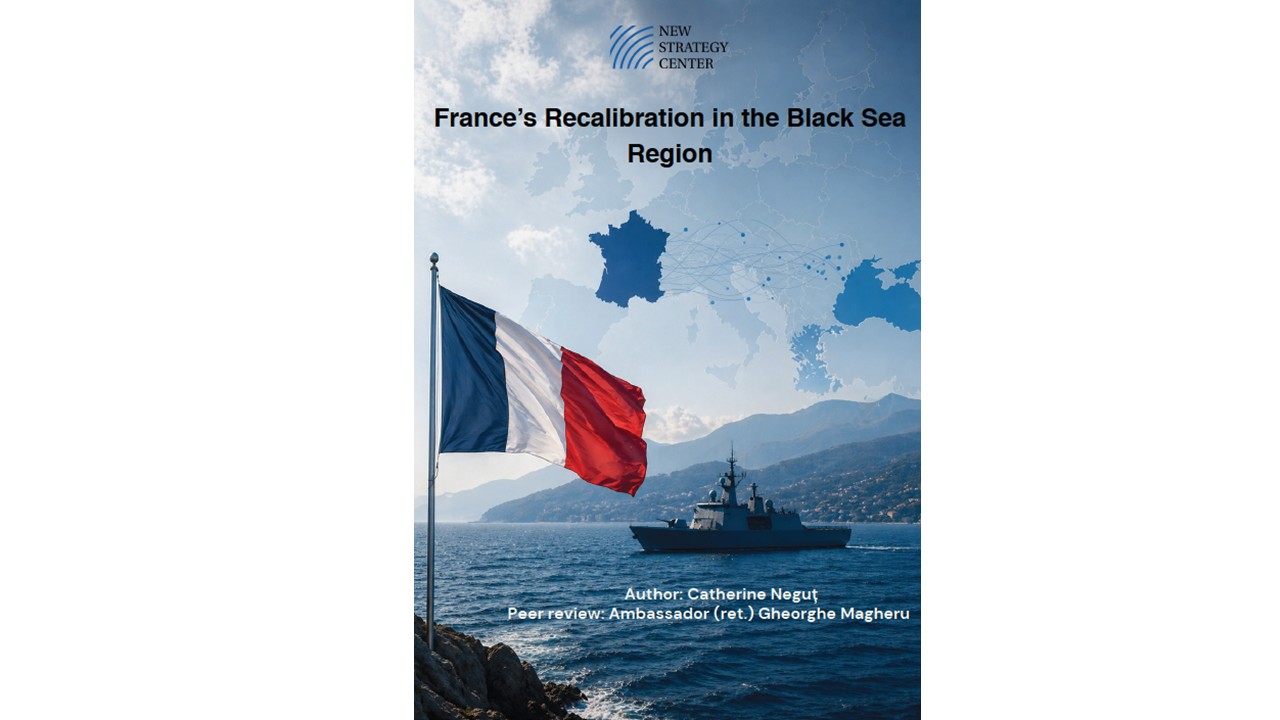
New Strategy Center has published a new study – “France’s Recalibration in the Black Sea Region” – which analyzes France’s policy in the Black Sea region in the context created by Russia’s full-scale invasion of Ukraine in 2022 and by transatlantic developments that are catalyzing Europe’s strategic autonomy.
The paper highlights France’s relations with the countries of the Black Sea region, the way France’s attitude toward Russia has evolved, its consistent support for Ukraine, and its backing of the Republic of Moldova’s European integration process. One chapter is dedicated to the extensive relations between France and Romania, seen as a key pillar of French interests in the region.
It also underscores the growing importance of the Black Sea region as a central arena where European security, energy and connectivity interests, and Russian revisionism intersect, making France’s role even more relevant for the security of NATO’s Eastern Flank and for the overall European security architecture.
The study is authored by Catherine Neguț, an international expert at New Strategy Center, and the peer review was conducted by Ambassador (ret.) Gheorghe Magheru, a member of the Scientific Council of the New Strategy Center.