
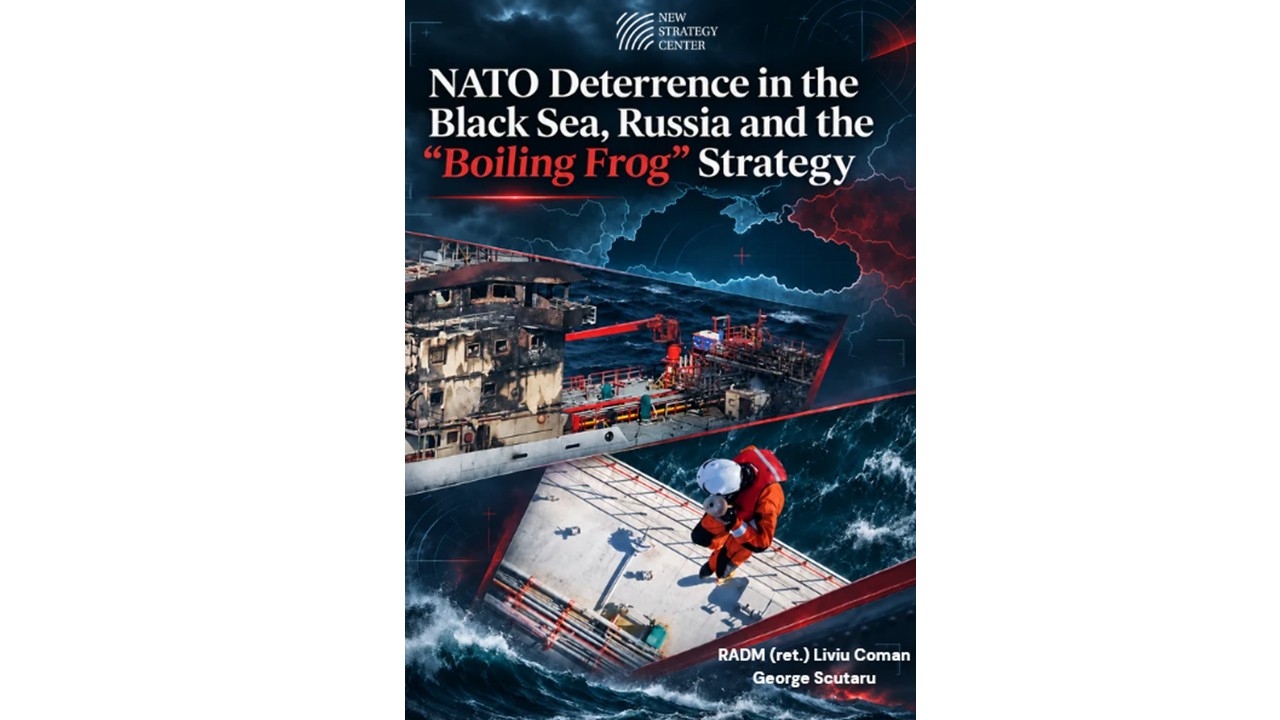
New Strategy Center is publishing a new study entitled “NATO Deterrence in the Black Sea, Russia and the ‘Boiling Frog’ Strategy”, which examines the escalation of Russia’s attacks against commercial vessels in the Black Sea and their implications for Romania’s security and the credibility of NATO’s deterrence policy.
The study highlights the growing risks to freedom of navigation, critical energy infrastructure and global food security, as well as the gaps in Romania’s and Bulgaria’s intelligence, surveillance and reconnaissance (ISR) capabilities and their ability to counter aerial and naval drones.
The authors emphasize the need for a much stronger NATO response and propose the establishment of a permanent Allied maritime security mechanism in the Black Sea, called “Neptune Sentry”, inspired by the “Baltic Sentry” model and adapted to the region’s specific legal and strategic circumstances. The study also highlights the need for Türkiye to assume greater responsibilities in the maritime domain, taking into account its policy of promoting regional ownership.
The study is co-authored by Rear Admiral (Ret.) Liviu Coman, Senior Associate Expert at New Strategy Center and former Commander of the Romanian Maritime Component Command, and George Scutaru, CEO of New Strategy Center and former Presidential Adviser on National Security.
NATO Deterrence in the Black Sea, Russia and the ‘Boiling Frog’ Strategy