
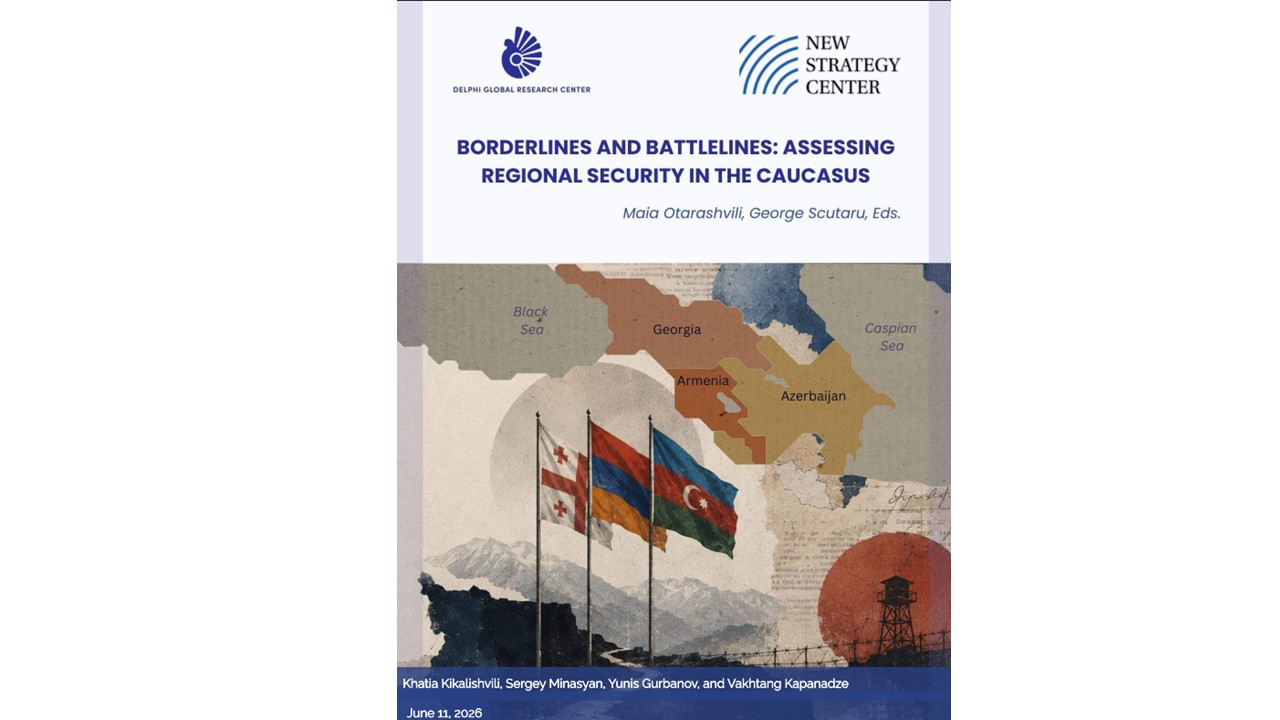
Assessing regional security in the South Caucasus requires treating the region not as a peripheral post Soviet space, but as a central hinge between the Black Sea, Caspian Sea, Central Asia, Türkiye, Iran, Russia, and Europe. The region’s security environment is shaped by overlapping pressures: unresolved or recently transformed conict dynamics between Armenia and Azerbaijan; Georgia’s democratic backsliding and vulnerability to Russian coercion including through its Russia-occupied regions of Abkhazia and South Ossetia; Armenia’s eort to preserve democratic resilience despite pressure from Moscow; and the broader strategic eects of Russia’s war against Ukraine. These dynamics make the South Caucasus a key test case for whether smaller states can preserve sovereignty, political agency, and diversied external partnerships in an increasingly competitive Eurasian security order.
The South Caucasus is also a corridor region whose security is inseparable from trade, energy, infrastructure, and great-power competition. The Middle Corridor, linking Asia and Europe while bypassing Russia, has gained new importance since Russia’s full-scale invasion of Ukraine and the imposition of sanctions on goods transiting Russian territory. This has increased the strategic value of Azerbaijan and Georgia, while also tying the South Caucasus more closely to developments in Central Asia, Türkiye, and the Caspian Sea. At the same time, new patterns of military cooperation among Azerbaijan, Türkiye, and Central Asian states suggest that regional security architectures are evolving beyond older Russian-dominated frameworks. Assessing security in the South Caucasus, therefore, requires an integrated approach that considers military risks, domestic resilience, Russian and Iranian spoiler capacity, Turkish inuence, energy transit, and the region’s potential role in strengthening Euro-Atlantic access to Central Asia.
As we enter this new phase of power dynamics in the South Caucasus, a set of questions merits thorough examination:
• How have recent conicts in the South Caucasus reshaped regional power balances and security perceptions?
• How do Russia, Türkiye, Iran, and Western actors compete and cooperate in shaping Caucasus security dynamics?
• To what extent does growing Chinese economic engagement aect regional security calculations?
• What scenarios could most plausibly destabilize the region in the coming decade, and how can they be mitigated?
In order to address these questions, the New Strategy Center and Delphi Global Research Center convened a roundtable discussion at the tenth edition of the Black Sea and Balkans Security Forum, organized by the New Strategy Center, in Bucharest, Romania, bringing together experts from Armenia, Azerbaijan, Georgia, Germany, and the United States. This report is a product of those discussions.
Borderlines and Battlelines: Assessing Regional Security in the South Caucasus